

I often get asked why I created a different adaptation from the original Business Model Canvas by Alex Osterwalder. Here is the thought process that went into creating Lean Canvas, how the two canvases compare, and when to use each.
At a Glance
| Dimension | Lean Canvas | Business Model Canvas |
|---|---|---|
| Creator | Ash Maurya (2010) | Alexander Osterwalder (2010) |
| Purpose | Startup validation under uncertainty | Business model design and communication |
| Best for | New ventures pre-Product/Market Fit | Established businesses or corporate innovation |
| Focus | Risk and learning | Architecture and value delivery |
| Key philosophy | Find the riskiest assumption, test it | Map the business model holistically |
| Time to complete | 20 minutes | 45-60 minutes |
| Primary audience | Founders, solo entrepreneurs | Product teams, consultants, corporate strategists |
The Backstory
May 2010 — I was first exposed to the Business Model Canvas through Alex Osterwalder’s book Business Model Generation. While I found the book beautifully illustrated, I originally dismissed the canvas approach as “too simple.” Many of the examples illustrated the business models of well-known companies like Apple and Skype — after they were successful. I was more interested in the “learning” that got them there.
June 2010 — It was not until I saw fellow entrepreneur Rob Fitzpatrick’s variation (Startup Toolkit) that incorporated Steve Blank’s worksheets from The Four Steps to the Epiphany that I took a more serious look at the canvas. The thought of capturing business model hypotheses on a single page seemed killer. I modeled my existing products using both canvases, which prompted me to do some tinkering of my own.
August 2010 — I shared my adaptation (Lean Canvas) in a post: “How I Document My Business Model Hypotheses.” This post quickly became one of my top posts of all time. I started using and testing Lean Canvas with other startups in my workshops and was particularly encouraged by its ability to enable more learning versus pitching conversations.
February 2011 — Lean Canvas also became a critical part of the methodology described in my book Running Lean — first self-published as an ebook, now in its third edition from O’Reilly.
Design Goals
My main objective with Lean Canvas was to make it as actionable as possible while staying entrepreneur-focused. The metaphor I had in mind was a ground-up tactical plan that guided the entrepreneur from ideation to building a successful startup.
I had already been working with Lean Startup principles, which had a big influence on the design.
“Startups operate under conditions of extreme uncertainty.” — Eric Ries
My approach to making the canvas actionable was capturing that which was most uncertain, or more accurately, that which was most risky. I found the initial Business Model Canvases I created missing things I would consider very high risk, while other things on the canvas did not register as high enough risk. Because the canvas is already quite space-constrained, it was important to maximize the signal-to-noise ratio. So I started trading boxes.
What I Added
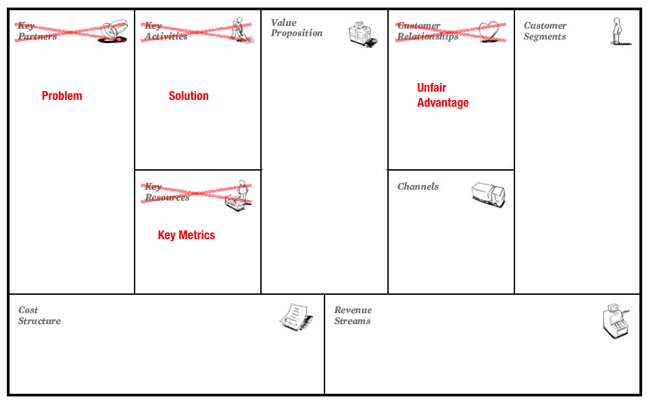
Problem — Most startups fail not because they fail to build what they set out to build but because they waste time, money, and effort building the wrong product. A significant contributor to this failure is a lack of proper “problem understanding” from the start.
“A problem well stated is a problem half-solved.” — Charles Kettering
Solution — Once you understand the problem, you are in the best position to define a possible solution. I purposefully constrained this box because the solution is what we are most passionate about. Left unchecked, we fall in love with our first solution and corner ourselves into legacy. Keeping the box small aligns with the Minimum Viable Product concept.
Key Metrics — Startups often drown in a sea of numbers. At any given point in time, there are only a few key actions that matter. Failure to identify the right key metric can be catastrophic — leading to premature optimization or running out of resources chasing the wrong goal.
“A startup can only focus on one metric. So you have to decide what that is and ignore everything else.” — Noah Kagan
Unfair Advantage — This is another name for competitive advantage or barriers to entry. Few startups have a true unfair advantage on day one, which means this box will often be blank. It is not intended to discourage you but to continually encourage you to work toward finding your unfair advantage. Once you achieve initial success, competitors and copycats will enter the market.
“A true unfair advantage is something that cannot be easily copied or bought.” — Jason Cohen
What I Took Out
“Perfection is achieved, not when you have nothing left to add, but nothing left to take away.” — Antoine de Saint-Exupéry
Key Activities and Key Resources — Both boxes were more “outside-in” focused — they helped outsiders looking in to understand what the startup did. I found myself listing things like “Customer Development” and “Software Development” that did not register high enough on risk to warrant keeping. Key Activities can be derived from the Solution box after the MVP undergoes testing. Key Resources align more closely with Unfair Advantage in an era of cloud computing, open source, and globalization.
Customer Relationships — I advocate starting every product with a direct customer relationship through interviews and observation, then identifying the appropriate path to customers. This is better captured by the existing Channels box.
Key Partners — This was the hardest to remove. Yes, some products require establishing key partnerships first — building a global solar energy grid with huge capital and regulatory requirements, for example. But most products do not fall into this category. When you are an unknown startup with an untested product, pursuing key partnerships from day one can be a form of waste.
When to Use Which
Use Lean Canvas When:
- You are starting a new venture and have not validated product-market fit
- You need to identify and prioritize risks quickly
- You are a solo founder or small team that needs to move fast
- You want a tool that naturally feeds into experiment design
- You are in an accelerator, incubator, or lean startup program
Use Business Model Canvas When:
- You are documenting an existing, working business model
- You are doing corporate innovation and need stakeholder buy-in
- You are analyzing competitors’ business models
- You need to communicate a model to investors who expect BMC format
- You are planning operations past the product-market fit stage
Common Questions
Why extend the BMC rather than creating something new? Even though it may have been easier to lay out a new canvas differently, I chose to work within the existing layout to attribute the work back to Alex Osterwalder’s original canvas. He licensed the original under Creative Commons and invited others to “Share & Remix” — making this a no-brainer.
Who is the audience for Lean Canvas? Lean Canvas was designed for entrepreneurs, not consultants, customers, advisors, or investors. That said, entrepreneurs benefit greatly by engaging all of those people while validating their canvas.
Should I start with Lean Canvas and then switch to BMC? Use what is most natural for you. I have used Lean Canvas successfully from ideation to Product/Market Fit and beyond. The risks captured on Lean Canvas are not just early-stage risks — they morph and evolve throughout the startup lifecycle.
Why have both Problem and Unique Value Proposition? The Problem box captures the top problems customers face, while the UVP is the marketing promise that stems from the intersection of the Problem and Solution boxes. For example, a job seeker’s problem might be “getting noticed by a prospective employer,” the solution might be “professionally designed resume templates,” but the UVP might be “Land your dream job in 60 days or less.”
Where do competitors go on the Lean Canvas? I am less interested in listing well-known competitors we build into investor pitches and more interested in how customers deal with their problems today. Your true competition is not who you think they are, but who your customers think they are. There is an “Existing Alternatives” sub-section under the Problem box for this purpose.
Why have both UVP and Unfair Advantage? The job of a UVP is to capture a customer’s attention, while the job of the Unfair Advantage is to deter copycats and competitors. These two are often not the same thing. For example, Facebook’s UVP was “Connect and share with the people in your life.” Their unfair advantage was large network effects.
The Verdict
This is not a contest — it is a question of fit. The Business Model Canvas is the better tool for mapping and communicating established business models. The Lean Canvas is the better tool for startups navigating uncertainty.
If you are pre-product-market fit, start with Lean Canvas. Once your model is validated and you are scaling, the BMC becomes more useful for operational planning and communication.
The worst thing you can do is spend weeks perfecting either canvas without testing the assumptions it contains. A canvas is a starting point for action, not a deliverable.